

Turntable Beginners Guide

Posted by LP Tunes on

Turntable Beginners Guide

If you are just getting started with vinyl or just need a refresher on the parts of a turntable, look no further!

Hey there! Are you just getting started in the world of vinyl? Or perhaps, would you just like to know more about your turntable and the parts that make it up? Either way, we are here to share some knowledge with you that will educate and may assist you in finding the right parts for your turntable.

The following is a list of the parts of a basic turntable. You may have something similar to this or maybe even something a bit more advanced, but for now we’ll go over the core components.

Plinth – This is the base of the turntable. It holds all of the components up and usually houses the motor. It can be made of many different shapes, sizes, weights and materials.

Platter – The platter sits atop the plinth and it is what the record rests on. Some turntables require a mat be placed between the record and the platter to protect the record.

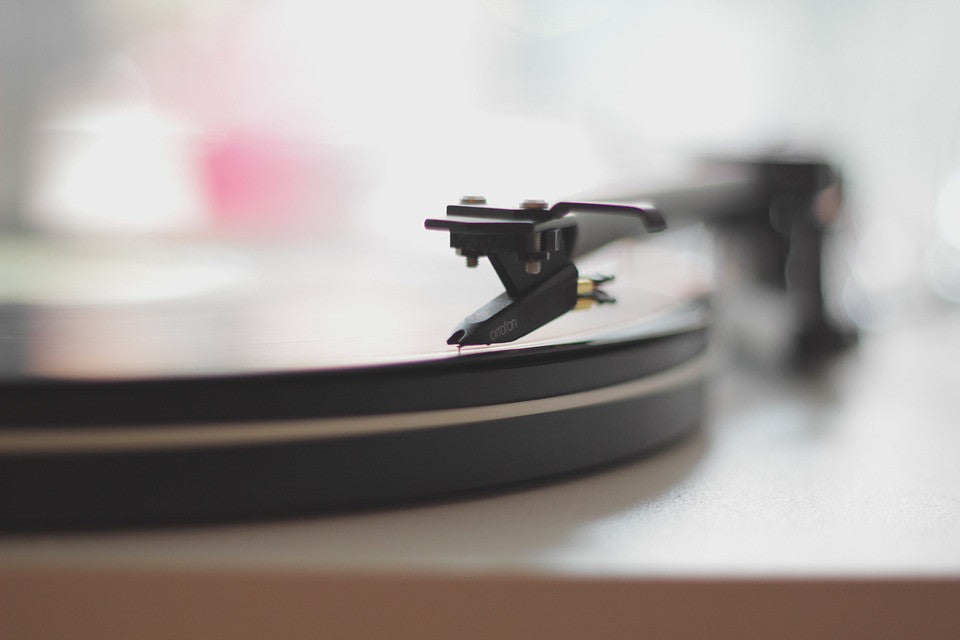
Tonearm – The tonearm usually sits to the right of the platter and it holds a headshell or P-mount cartridge. Tonearms can be straight or s-shaped.

On the tonearm:

Headshell – The headshell connects to the tonearm and holds a standard/half-inch mount cartridge.

Cartridge – The cartridge holds the stylus. They come in two types, standard/half-inch mount and p-mount types.

  • Standard/half-inch mount– This type of cartridge must be installed onto a headshell by connecting the wires from the headshell to it and also inserting two vertical headshell screws to hold the cartridge in place.
  • P-mount– These cartridges plug straight into a tonearm that was designed to be compatible with them. No headshell is required but, there is usually a single horizontal screw to hold the cartridge in place.

Stylus – The stylus, also known as a needle, is what moves along the grooves of the record. There are many different types of styli, the most common being: spherical/conical and elliptical, the former being less expensive and the latter being more due to the quality of playback being better.

Counterweight – This balances the tonearm to a horizontal state so that the stylus does not apply too much or too little pressure on the record.

Anti-skating Dial or Weight – As a stylus moves, it is drawn towards the center of the record and to the side of the record’s tracks. The anti-skating dial/weight prevents the stylus from wearing too heavily on the inner wall of the track on the record, which can unbalance the sound produced as well as the wear on the stylus.

Motor – Your turntable motor will usually be a direct drive or a belt drive. Audiophiles prefer belt drive, though direct drive can deliver high sound quality, whereas in the case of DJs, direct drive is the standard due to its higher torque and the fact that over time, drive belts will wear and begin to slip because of excessive back and forth force.


Share this post


Newer Post →


Leave a comment

Please note, comments must be approved before they are published.

JOIN OUR NEWSLETTER

Stay in the loop with LP Tunes sales, promotions & deals!

★ Reviews ★

Let customers speak for us

4075 reviews
94%
(3816)
5%
(224)
0%
(20)
0%
(4)
0%
(11)
Þ
LP Tunes Upgrade stylus for HYM Seed turntable
Þorgeir Valur Ellertsson (Hafnarfjordur, IS)

Fast and every thing as expected.

J
Stylus for ADC WXL-1 WXL1 cartridge
Janet Catlett (Vienna, US)
Good cartridge

I had a hard time finding this Stylus. Finally found it at KP Tunes, price was good and it came quickly. Worked so well I bought another as a backup

Unfortunately the belt was not correct, but LP Tunes made it right

The belt was thinner than the OEM belt, and ran at 32.1 rpm, I contacted LP Tunes and the refunded my payment this morning.

Great service. Hopefully they will review their belts for the Roksan Radius and in future they will work accurately. Can’t ask for more than this though, they cannot own every turntable.

Exactly the item that I was looking for.

Product fits and sounds very good.

Great product, great price!

Picked up a new turntable to match my other AT-LP120, an excellent product. Thanks to LP Tunes for the responsive customer service and free shipping!

Great product

Works great ..as advertised!

Does exactly what it is supposed to do, and does it well

I was looking for a turntable to transfer a couple hundred vinyl records to digital format. Since whatever setup I used for the transfer would be how I heard all those LPs from now to forever, it seemed to make sense to avoid cheaping out. OTOH, it's not worth it to me to spend thousands of dollars on an esoteric audiophile turntable. We already have a Pro-Ject Debut Carbon Evo turntable in the living area with the stereo, but I didn't want to commandeer that unit for transfer purchases,. That unit wins all the awards for "best under $1000 setup", but I'd need an external phono preamp and A/D converter, pushing the total cost to over $1k. The AT-LP120XUSB is less expensive and includes everything needed to connect to the PC, so it was an attractive option.

After reading a bunch of reviews of various turntables, I came to the conclusion that I was overthinking it and just went with this model. This turns out to be the right choice for my purposes. Once I had it set up I compared it directly with the Pro-ject unit, and the differences were subtle, if there were any audible differences at all. It works, it sounds good, and seems quite durable.

PROS:
o Setup is straightforward, since the TT, tonearm, headshell, cartridge, and stylus were all engineered together.
o The included stock AT-VM95E cartridge/stylus is well regarded and allows for an easy upgrade if you want a better stylus.
o Solidly built in the tradition of the Technics 1200 that it is modeled after.
o Professional quality internal phono preamp and A/D converter.
o Sounds basically identical to a unit twice the price
o Does basically everything it's supposed to do, and does it well.
o Since it's a DJ turntable, it should hold a good resale value - once I'm done digitizing the records I have I'm probably done with it so I might sell it at that point.

CONS:
o If you try to use both the USB and analog line out simultaneously there's a prominent high pitched whine - the engineers did not adequately isolate the two from ground loops - while this is a disappointment to me, there are easy work-arounds and few people are going to connect both.
o It's fully manual, so perhaps not the best choice if you just want to play records.
o If you have a receiver with a phono preamp, you don't need the internal one or the A/D converter so you'll be paying for things you don't use
o Your audiophile buddies will not be impressed.