

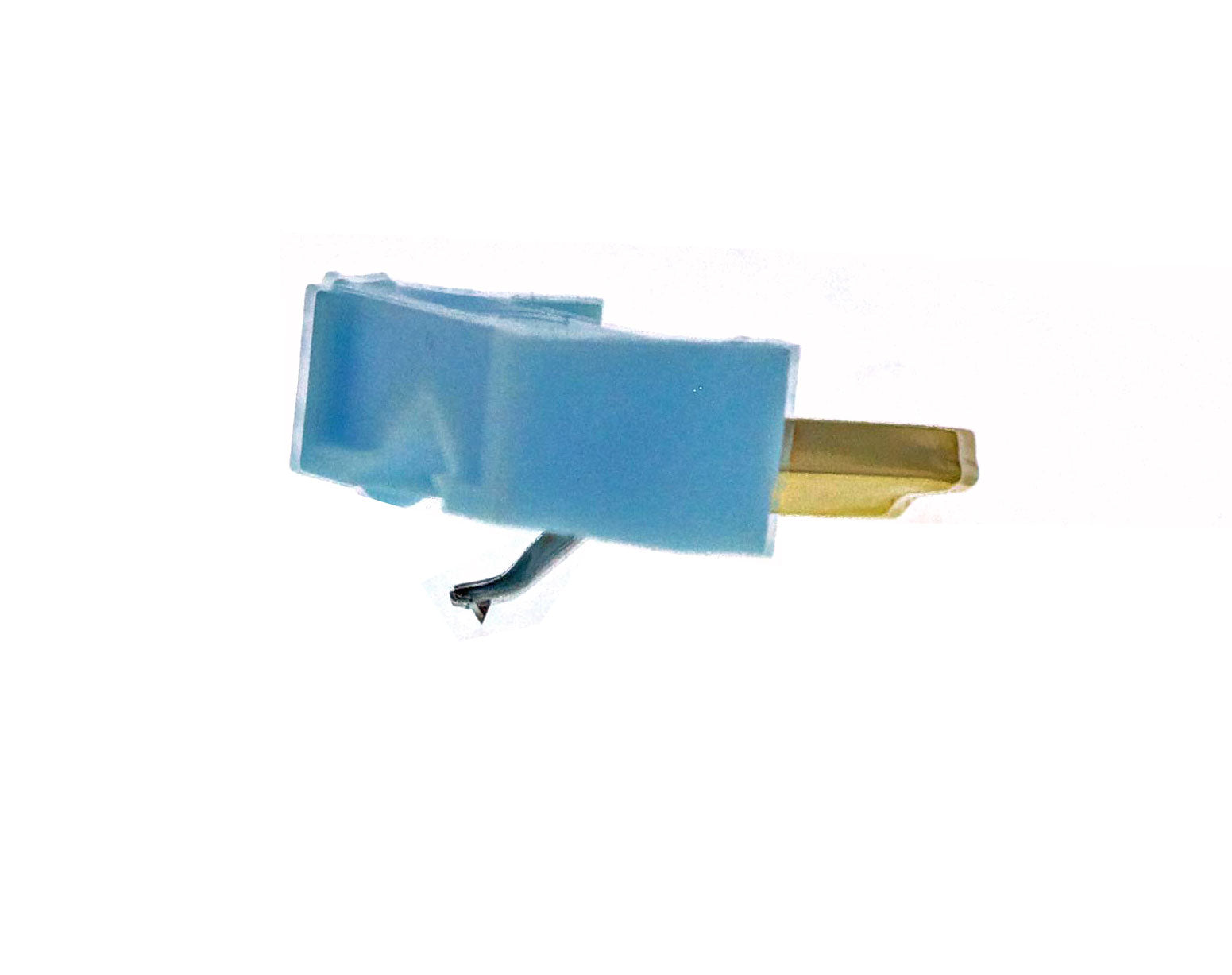
Other Equipment

H&H (Half & Half) consists of 50% Gold and 50% Silver 8-nano meter particles (8/1,000,000 mm) dispered in Super Squalene Oil. Gold and Silver work as an ideal electron carrier between two metal contacts facing each other. Also the Super Squalene Oil cleans, covers and protects the surface from oxidation and sulfation.
The Nanotec H&H Contact Pro offers these advantages:
- Eliminates the electronic barrier on connecting points
- Its 8-nano meter particles (8/1,000,000 mm) cover the uneven contact metal surface for an ideal surface to surface connection
- Stablizes the electric current thus lessening noise and distortion
- Cleans, covers and protects the surface from oxidation and sulfation
- The liquid, oil-based Nanotec H&H Contact Pro resists drying up and thus offers many years of continued superior performance
Just swipe and you're on the way to hearing more music lost in between the contact joints.Vocals sound pure and natural. Harshness is diminished form the very low bass to the ultrasonic high frequencies. Treat the ends of your interconnects, input plugs, speaker connections, A/C cords, fuse holders, phono cartridge and headshell pins and more.
With this 1 mL bottle, more than 500 points of contact will be covered for standard applications.
There is no need to pay more. Others cost much more yet won't deliver more.
How to use the Nanotec H&H Contact Pro:
1) Apply a small amount of the liquid to the surface of the input plug and jack
2) Connect and disconnect the plug to spread the liquid.
3) Then re-connect.
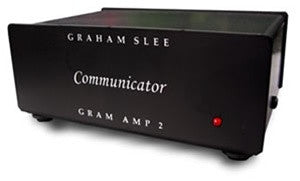
Graham Slee Gram Amp 2 Communicator phono preamp
The Gram Amp 2 Communicator phono preamp is a stripped down professional performer specifically designed to give the record playing listener on a low budget full scale performance you won't get from anything else close to its price. Starting out life as the "plain" Gram Amp 2, it earned legendary status within weeks of its introduction back at the turn of the century in the year 2000. Ten years plus onward, it retains its original circuit configuration and thus offers full scale musical performance that sounds exceptionally superb. To be able to continue making this astonishing phono stage preamp at a price you can afford Graham Slee stripped out all the costly cosmetics and what remains is a small, neat and presentable aluminum box with "musical gold" on the inside! The Gram Amp 2 Communicator phono stage preamp is supplied with a universal voltage energy efficient plug-in wall power supply. It can also be powered by the PSU1 power supply which can be ordered separately.
Gram Slee Gram Amp 2 Communicator Phono Preamp Specifications
-Input sensitivity range @ 1kHz,5cm/sec: 3.5mV (will accept 2mV to 10 mV)
-Output range: 300mV (170mV to 860mV with "will accept" input range)
-Maximum input @ 1kHz: 54mV
-Input impedance: 47k ohms
-Input impedance capacitive: 100 pF
-Output noise: -77dB (CCIR Q-pk 22Hz - 22kHz)
-Equivalent input noise (EIN): -115dB
-Reproduction characteristic: RIAA accuracy within 0.5dB total deviation 20Hz-20kHz
-Channel balance: 0.1dB
-Channel separation: 64dB
-Dimensions: 4.5"w x 1.75"h x 3.5"d
Reviews
"What I didn't expect was for it to sound stage like a four-figure preamp"
- Geoff Husband, TNT Audio (February 2001)
"It concedes little indeed to more expensive designs and kept us entertained for hours. Timing is first-rate, instrumental timbre convincing and detail resolution frankly impressive..."
- Hi-Fi Choice (December 2001)
"Switch to the power rock of Led Zeppelin II and the Gram Amp 2 delivers both crashing cymbals and deep thundering bass with ease" - What Hi-Fi? Sound and Vision (June 2002)
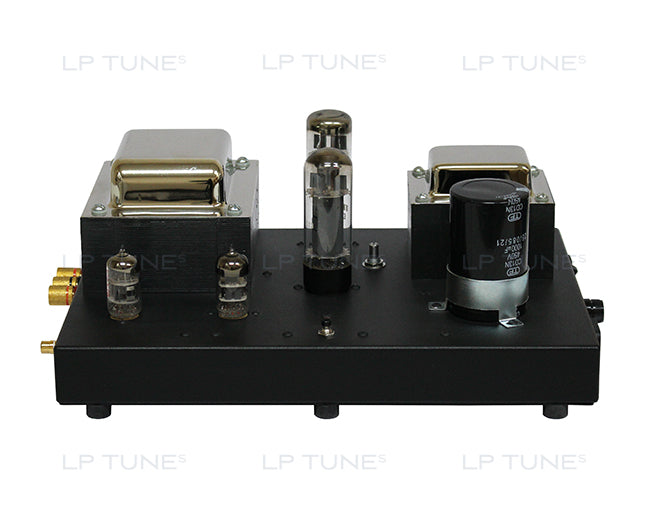
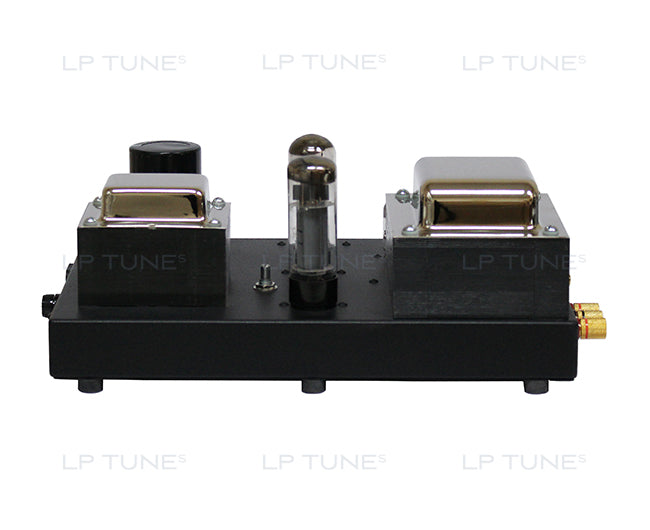
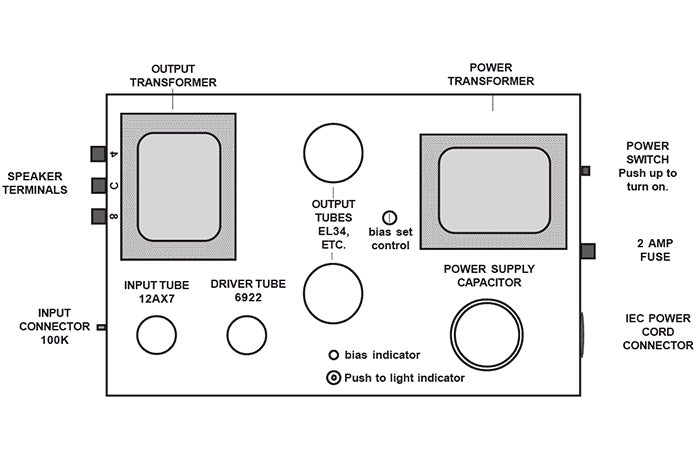
Quicksilver Mid Mono Amplifier (One Pair)
QUICKSILVER MID MONO AMPLIFIER (ONE PAIR)
Quicksilver’s Mid Mono amplifier is completely hand-wired and can use many different output tubes; the Mid Mono has a low loss output tramsformer, adjustable bias, high power and five-way gold-plated binding posts. Setting the bias is very simple: one screwdriver control and an LED indicator. Power is 40 watts at 50% triode operation with the standard EL34s and 45 with KT88s.
Quicksilver Mid Mono Amp Specifications
- Power output: 40 watt into 4 or 8 ohms
- Power bandwidth: 16Hz - 35kHz
- Input sensitivity: 1.25 volts
- Input impedance: 100k ohms
- Power consumption: 105 watts @ idle; 210 watts @ full power
- Tube compliment: one - 12AX7; one - 6922 driver; two - EL34 outputs
- Finish: Black chassis, chrome transformer covers
- Dimensions: 5.5"h x 14.5"d x 9.125"w
- Weight: 28 lbs
- Warranty: 3 years parts and labor, tubes 90 days
Pure silver 8-nano meter micro particles (8/1,000,000 mm) are dispered in Super Squalene Oil. Silver is the most conductive material. Also the Super Squalene Oil cleans, covers and protects the surface from oxidation and sulfation. The Nanotec Silver Contact Pro is a recipient of the Visual Grand Prix 2009 Award.
The Nanotec Silver Contact Pro offers these advantages:
- Eliminates the electronic barrier on connecting points
- Its 8-nano meter particles (8/1,000,000 mm) cover the uneven contact metal surface for an ideal surface to surface connection
- Stablizes the electric current thus lessening noise and distortion
- Cleans, covers and protects the surface from oxidation and sulfation
- The liquid, oil-based Nanotec Silver Contact Pro resists drying up and thus offers years of continued superior performance
Just swipe and you're on the way to hearing more music lost in between the contact joints. The soundstage becomes larger and when used with audio-video, the picture becomes brighter. Treat the ends of your interconnects, input plugs, speaker connections, A/C cords, fuse holders, phono cartridge and headshell pins and more.
With this 1 mL bottle, more than 500 points of contact will be covered for standard applications.
There is no need to pay more. Others cost much more yet won't deliver more.
How to use the Nanotec Silver Contact Pro:
1) Apply a small amount of the liquid to the surface of the input plug and jack
2) Connect and disconnect the plug to spread the liquid.
3) Then re-connect.
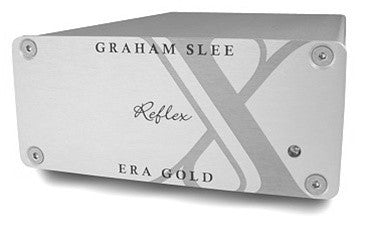
More music from moving magnet cartridge! The Graham Slee Reflex M phono stage preamp is the phono preamp for moving magnet, moving iron and high-output moving coil phono cartridges. The next stage following the exceptional legacy and world class standing of the Reflex, the Reflex M delivers musical reality that is closest to the recorded grooves.
One of the great innovations that made the Era Gold V phono stage preamp miraculous and the Reflex our next generation of Stereophile "Class A" recommended phono stage pre amps is their extremely good open loop linearity.
Negative feedback is used in most all amplifier stages to straighten their open-loop distortion, but often lashings of negative feedback has to be used to force them into linear operation. But as tube amp enthusiasts know, lots of negative feedback doesn't do good music.
The Reflex M phono stage preamp is highly linear before negative feedback is applied. The result is an uncanny reality that transports the listener into a very involving musical experience.
In areas where radio breakthrough is a problem, the Reflex M has been exhaustively tested and refined to reject radio frequencies. It cannot oscillate and tune a radio frequency.
Power Supply
The Reflex M phono preamp comes with the PSU1 linear power supply included and sounds best with it.
Graham Slee Reflex M Phono Preamp Specifications
- Input sensitivity range: 2mV to 10mV
- Output range (for above inputs): 224mV to 1120mV
- Maximum input: 46mV rms
- Maximum output: 5.2V rms
- Gain: 41dB (112) @ 1kHz
- Input impedance: 47k ohms plus 100pF (200pF approx. with arm cable capacitance)
- Output impedance (driving impedance): 1k ohms (will drive 10k ohms and above)
- Noise at output: -73dB CCIR Q-pk; EIN: -114dB
- Distortion: typically 0.01%
- RIAA accuracy: <0.3dB
- Frequency response: 20Hz - 200kHz ("flat", corrected to RIAA)
- Channel balance: 0.2dB
- Channel separation: 60dB
Reviews
"...it was among the most well-balanced phono pre amps I've heard of any technology at any price. It got out of the way and let the music do the talking with great clarity and definition"
- Michael Fremer, Analog Corner, Stereophile; September 2007
"On a track like "Looking for the Heart of Saturday Night" ... the Reflex was the more dimensional performer, especially in front-to-back depth" - Neil Gader, Graham Slee Era Gold V and Era Gold Reflex, The Absolute Sound; June 2, 2009
Warranty
Should this product fail while being used for its intended purpose, within one year of purchase, we will repair or replace it at our discretion. Please contact LP Tunes for details. No other liability will be accepted. Your statutory rights are not affected.
Manufacturer
Graham Slee Projects Limited
1 Monks Way, Monk Bretton, Barnsley, S71 2JD, United Kingdom
+44(0)1226 244908 Tel/Fax
gsp.ltd@gspaudio.co.uk email
http://www.gspaudio.co.uk website
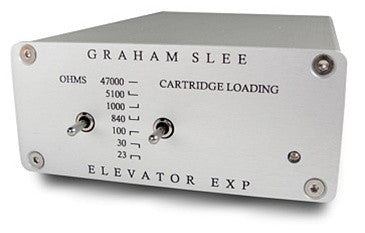
Graham Slee Elevator EXP Moving Coil Head Amplifier
GRAHAM SLEE ELEVATOR EXP MOVING COIL HEAD AMPLIFIER
The Graham Slee Elevator EXP moving coil head amp has received awards and distinctions that only a select few and the very best achieve, testaments of its world class stature and exceptional ability to deliver sound quality equal to or better than any MC head amp at any price.
The Graham Slee Elevator EXP (active step-up device) is designed to express the full performance of low output MC phono cartridges of the highest caliber. The complete lack of flywheel effect or hysteresis of transformers, correct cartridge matching, and fast low noise video bandwidth enable the Elevator EXP to deliver truly exceptional performance hence the awards stated above.
The Graham Slee Elevator EXP is a separate unit flat response 22,5dB gain stage (having its own outboard power supply) optimized for MC cartridges, that will boost the signal to Moving Magnet level. The less stressed MM phono stage that follows it, can then be realistically expected to deliver a good musical performance.
The Graham Slee Elevator EXP features video amplifiers that provide the bandwidth required for the absolute phase needed to reproduce instrumental and voice structure timbre, a sound-stage with depth and width, and the instant dynamics which makes the music and recording venue come alive.
Its input referred noise measures -130dB rms like studio microphone amps (Just take away your cartridge sensitivity in dB for the S/N). That means the hiss will be below the noise of a clean record, and in the case of the Elevator EXP, there is no hum provided the turntable components and arm lead are properly screened and grounded to the EXP ground post.
The Graham Slee Elevator EXP's distortion is near non-existent at less than 0.01% (including the test oscillator's 0.003% distortion).
Rather than being designed for the convenience of the manufacturer, the Graham Slee Elevator EXP sports its cartridge loading switches on the front panel. Furthermore, we've included all the resistive loads you've been asking for.
Each Elevator head amplifier is extremely transparent, allowing the true character and expression of your low-output MC cartridge to shine through.
Loading
The following cartridge loads are available via two front panel gold plated contact switches: 47,000 - 5,100 - 1,000 - 840 - 100 - 30 and 23 ohms.
Highest professional standards
Components used in the Graham Slee Elevator EXP are to the highest professional standards, including FR4 epoxy resin single and double sided plated through hole printed circuit boards, C&K gold plated contact switches, analog devices semiconductors, tantalum capacitors, Elna audio grade capacitors, Wima low inductance high speed polypropylene and silver/mica capacitors. Connections are by heavy gold plated, Teflon insulated deluxe phono jacks, and an additional arm earth is provided for convenience.
The case, which matches the Graham Slee Era Gold V, Jazz Club, Reflex, Revelation and Solo, is our unique construction aluminum extrusion base and top, with 3.2 mm thick front and rear panels. Finish is satin silver anodized aluminum.
Warranty
Should this product fail while being used for its intended purpose, within one year of purchase, we will repair or replace it at our discretion. Please contact LP Tunes for details. No other liability will be accepted. Your statutory rights are not affected.
Awards
Hi-Fi News Best Phono Stage Award for 2004
Best Phono Stage Under £1,000 Award at the 2005 Heathrow Hi-Fi Show
Class A Recommended Component Stereophile Vol.30 No.10 October 2007
Class A Recommended Component Stereophile Vol.31 No.4 April 2008
Class A Recommended Component Stereophile Vol.31 No.10 October 2008
Manufacturer
Graham Slee Projects Limited
1 Monks Way, Monk Bretton, Barnsley, S71 2JD, United Kingdom
+44(0)1226 244908 Tel/Fax
gsp.ltd@gspaudio.co.uk email
http://www.gspaudio.co.uk website

The Rega Saturn CD player offers the critical listener a higher level of musical discernment much like as one experiences from scaling up to a reference quality turntable. This has been achieved through painstaking research, convergent technologies and the application of 32 years experience in producing the finest in analog audio electronics.
Features
- CD player in black finish
- Two parallel connected Wolfson WM8740 dual differential digital to analogue converters improving the dynamic range and linearity
- Master clock provided by a high-stability, low-jitter crystal oscillator module
- Substantial 60VA toroidal transformer with separate windings for audio, digital and display circuits
- Digital to analogue converters utilizing solid polymer de-coupling capacitors
- Post DAC analogue amplifier and filter employ a cascade pair discrete class A amplifier using low base spreading resistance transistors
- Large double-sided PTH PCB with generous ground planes
- Unique high-tech operating system that optimizes itself for each CD
- Brand new transport mechanism, with the latest signal processing techniques and servo giving the best data retrieval
- MP3 and WMA Media capabilities
- Ultra high memory capacity meaning that error correction need not affect sound quality
- Rega custom built extruded aluminum case
- Solid aluminum front panel
- 'Toslink' & coaxial digital outputs
- New Rega CDP remote (in black) supplied as standard
Resources
Rega Saturn Instruction Manual
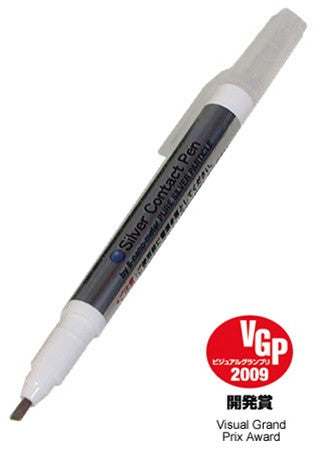
Silver 8-nano meter micro particles (8/1,000,000 mm) are dispered in Super Squalene Oil. Silver is the most conductive material. Also the Super Squalene Oil cleans, covers and protects the surface from oxidation and sulfation. The Nanotec Silver Contact Pen is a recipient of the Visual Grand Prix 2009 Award.
The Nanotec Silver Contact Pen offers these advantages:
- Eliminates the electronic barrier on connecting points
- Its 8-nano meter particles (8/1,000,000 mm) cover the uneven contact metal surface for an ideal surface to surface connection
- Stablizes the electric current thus lessening noise and distortion
- Cleans, covers and protects the surface from oxidation and sulfation
- The liquid, oil-based Nanotec H&H Contact Pen resists drying up and thus offers years of continued superior performance
Just swipe and you're on the way to hearing more music lost in between the contact joints. The soundstage becomes larger and when used with audio-video, the picture becomes brighter. Treat the ends of your interconnects, input plugs, speaker connections, A/C cords, fuse holders, phono cartridge and headshell pins and more.
The Nanotec Silver Contact Pen contains 0.2 mL of colloidal liquid for an estimated coverage of about 100 square centimeters.
There is no need to pay more. Others cost much more yet won't deliver more.
How to use the Nanotec Silver Contact Pen:
1) Apply a small amount of the liquid to the surface of the input plug and jack
2) Connect and disconnect the plug to spread the liquid.
3) Then re-connect.
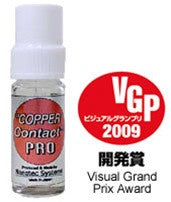
Copper is the metal that is extensively used in electronics and electrical transmission. Pure Copper 8-nano meter micro particles (8/1,000,000 mm) are dispered in Super Squalene Oil. The Nanotec Copper Contact Pro when applied to the connectors can have a dramatic effect on sound quality. It clarifies the sound image and delivers dynamics, detail and natural sound suitable to Jazz and Popular music. Also the Super Squalene Oil cleans, covers and protects the surface from oxidation and sulfation. The Nanotec Copper Contact Pro is a recipient of the Visual Grand Prix 2009 Award.
The Nanotec Copper Contact Pro offers these advantages:
- Eliminates the electronic barrier on connecting points
- Its 8-nano meter particles (8/1,000,000 mm) cover the uneven contact metal surface for an ideal surface to surface connection
- Stablizes the electric current thus lessening noise and distortion
- Cleans, covers and protects the surface from oxidation and sulfation
- The liquid, oil-based Nanotec Copper Contact Pro resists drying up and thus offers years of continued superior performance
Just swipe and you're on the way to hearing more music lost in between the contact joints. Treat the ends of your interconnects, input plugs and jacks, speaker connections, A/C cords, fuse holders, phono cartridge and headshell pins and more.
With this 1 mL bottle, more than 500 points of contact will be covered for standard applications.
How to use the Nanotec Copper Contact Pro:
1) Apply a small amount of the liquid to the surface of the input plug and jack
2) Connect and disconnect the plug to spread the liquid.
3) Then re-connect.
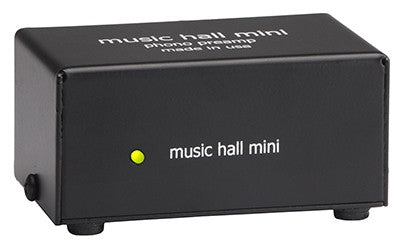
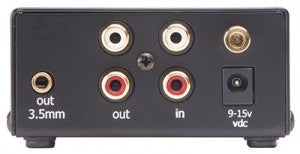
The Music Hall Mini is a solid state phono preamp for use with moving magnet (MM) and high output moving coil (HOMC) phono cartridges. The Mini is designed to amplify an RIAA equalized phono signal to a high level signal. It's unobtrusive, inexpensive, cheerfully good, and built in the USA.
Music Hall Mini Phono Preamp Details
- RIAA equalization: 20Hz to 20kHz +/- 1.5 dB
- I/O connectors: RCA, 3.5mm TRS stereo stereo
- Input sensitivity: 35 dB gain @1kHz, 47k Ohms Input Z
- Input capacitance: 5pf + cable capacitance
- Input impedance: 50k Ohms
- Output impedance: 1 K Ohms
- Max output level: >10dB @ 1kHz at .1% dist.
- S/N ratio: >80 dB unweighted
- THD: .02% @ 1KHz
- Power: 9 - 15 VDC
- Indicator: 1 power LED
- Casing: Steel chassis
- Dimensions: W3.25 x H1.5 x D2.0 in.
- Weight: 1.5 lbs pkg.
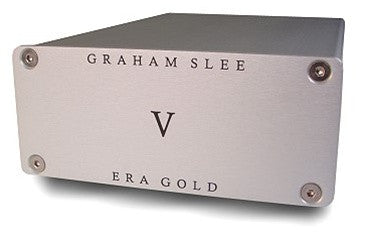
The Graham Slee Era Gold Mk V phono preamplifier is truly exceptional. It throws current thinking to the wind, and concentrates on its singular mission - that of reproducing music the way music sounds. The result is a phono preamp that breathes real music into life.
Michael Fremer, in Stereophile Vol. 27 No. 1, calls the Era Gold V the "miraculous phono preamp" for its ability to change and dramatically lift an entire system's sound quality and make music sound real! Subsequently, Stereophile awarded Class A $$$ Recommended Component rating on the Era Gold Mk V thus making it the least expensive phono preamp in this very exclusive class of superlative achievers. Others cost $1,500 - $15,000!
For Michael Fremer's complete review, click here.
For the TNT Audio Magazine review, click here.
The Era Gold Mk V is designed for use with the highest quality turntables, tonearms, moving magnet, moving iron, and high output moving coil cartridges which require a fixed 47k ohms load. This single-minded focus removes all design compromises thus setting the music free! Because there are no switch contacts in the signal path and because of its extremely fast amplifier stages with matched, high speed,low dielectric absorption RIAA networks, the Era Gold will retrieve detail from records with crystal clarity and precision, produce an amazingly accurate and stable stereo image, tight powerful bass and fantastic detail resolution with vast improvement to musical timing and timbre, along with the ethereal or ephemeral feel of valves. The resulting sound is startling in its musicality!
High-Performance Results
As with many high performance products, the results it gives will only be as good as the source feeding it, but with a good turntable-arm-cartridge combination the results will be heard. At last, much of the grittiness blamed on the vinyl medium is exchanged for real music. Brass, with its complex harmonic structure appears as it should, rather than the usual distortion you get with slower pre amps.
As, is usually the case, it's the attention to the smallest details which make the biggest difference to how things sound. With the Era Gold V, these small details are reproduced with such finesse that the music is brought to life. The life it had when committed to the master tape! Not just with modern high quality pressings or direct cut discs, but with used vinyl too, right back to the birth of RIAA stereo recordings.
How this is achieved is based on Graham Slee's concept of phase integrity, which can only be realized by fast electronics, which in turn is an art seldom understood, or achieved by other phono preamp manufacturers. Every natural sound has its harmonics. These harmonics carry the information our hearing needs to distinguish between instruments, voices, the particular way in which they are played or sung. They also carry the micro-information about the recording venue, the microphone placement, the reverb - natural or synthetic - sounds and energies that make up the backdrop to the recording, and that backdrops perspective.
The power supply used to power the Era Gold is the PSU1. It uses extremely low impedance, high temperature reservoir capacitors, paralleled for even lower impedance prior to a voltage regulator, which itself is very low impedance. Its 12 watt peak capability is far greater than the power demanded by the Era Gold.
Additionally, the voltage is regulated a second time within the phono preamp itself, providing an extremely clean power supply to the amplifiers. It is further improved by distributed tantalum capacitors. However, it is Graham Slee's attention to the signal ground which makes the biggest impact. The ground is many orders of magnitude more stable than any other phono preamp in the market, no matter how big the power supply!
The fast circuitry of the solid state Era Gold places it on par with many a tube phono preamp. In fact, it can be quite difficult to differentiate between it and a tube preamp. However the Era Gold carries none of the frequency limitations (Miller capacitance). Many have found it unbelievable that such a big, controlled and astonishingly musical sound can be "made" by such a small "box".
The Era Gold V phono preamp is powered by the outboard PSU1 power module which is included.
The Listener's Phono Preamp
A listener enjoys music and is persnickety about it. He/she will take the time to assemble components that will maximize the musicality of his/her playback system. This applies whether the system is modest or stratospheric. It's an attitude towards music and much about life really. This attention to detail differentiates the true listener from the equipment lover.
The Era Gold V is the listener's phono preamp because it brings real music to life. It also requires patience. It requires a month of actual use before it will let you experience its grandeur. Afterwards, the Era Gold V becomes "miraculous."
Graham Slee Era Gold MK V Phono Preamp Specifications
- Phono connectors: Heavy gold plated
- Input sensitivity: 2mV - 9mV
- Input impedance: 47k and 100pF
- Output: 240mV - 1.08V
- Headroom: 26dB ref 2mV input
- Output noise "A" wtd.: -75dB
- Distortion: <0.02%
- Frequency response: 10Hz - 2.7MHz
- Reproduction curve: RIAA with 50kHz EQ
- Dimensions (mm): 170 x 117 x 50
- Shipping weight: 5 lbs.
Warranty
Should this product fail while being used for its intended purpose, within one year of purchase, we will repair or replace it at our discretion. Please contact LP Tunes for details. No other liability will be accepted. Your statutory rights are not affected.
Manufacturer
Graham Slee Projects Limited
1 Monks Way, Monk Bretton, Barnsley, S71 2JD, United Kingdom
+44(0)1226 244908 Tel/Fax
gsp.ltd@gspaudio.co.uk email
http://www.gspaudio.co.uk website
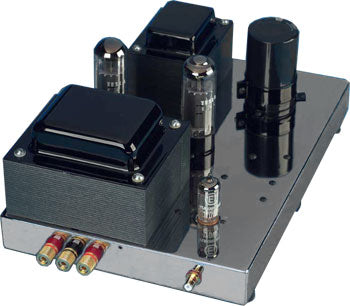
QUICKSILVER HORN MONO AMPLIFIER
The Horn Mono Amplifier is designed specifically for use with very efficient loudspeakers. It has extremely low noise and distortion and approximately 18db less gain than Quicksilver's standard amplifiers. This avoids the noise and gain problems that normally appear when using horn speakers. The amplifier is designed to sound superb at the extremely low levels (milliwatts) that horn loudspeakers require. Many amplifiers actually have higher distortion at these low levels.
As with all Quicksilver amplifiers many different output tubes may be plugged in directly with no adjustments: matched pairs of EL34, KT90, KT88, KT77, KT66, 6550 or 6L6 output tubes. The power supply has over 100 joules of storage and the power cord has an IEC connector.
Quicksilver Horn Mono Amplifier Specifications
- Power output: 25 watts into 4 or 8 ohms from 20Hz to 20 KHz
- Power bandwidth: 9Hz - 100kHz
- Peak power: 50 watts
- Input sensitivity: 9 volt
- Input impedance: 100k ohms
- Tube complement: 1-12DW7 and 2-EL34 output tubes
- Chassis: Chrome over nickel
- Dimensions: 6"h x 14 3/4"d x 9 1/4"w
- Weight: 30 lbs.
- Warranty: 3 years parts and labor, tubes 90 days
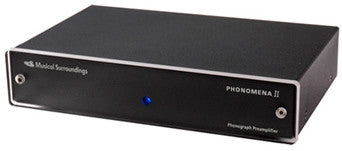
Musical Surroundings Phonomena II phono preamp
A recipient of The Absolute Sound Editors' Choice Award in 2009, 2010, 2011, 2012 and 2013, the Phonomena II phono preamp is based on the latest discrete circuit of the highly rated Nova Phono Preamplifier - without the battery pack. It offers outstanding sound quality and flexbility to match with moving magnet and low, medium or high output moving coil cartridges. The sound of the Phonomena II is alive and electrifying with its release of dynamic energy. For balance and value, the Phenomena II phono preamp is a stunner.
The Phonomena II is a complete phonograph preamp with RIAA equalization that amplifies the output signal of a phonograph cartridge, either moving magnet or low-output moving coil, up to a nominal line level. The Phonomena II may be used with a receiver or an integrated amplifier. If it is to be used with separate components, a line level control unit (preamplifier) is required before the power amp, since there is no independent volume control included with the Phonomena II. The Phonomena II is powered by a separate wall-mount transformer.
Phonomena II Phono Preamp Specifications
- Gain switches: 40, 44, 46, 48, 50, 51.5, 52.7, 53.7, 56, 57.5, 58.4, 59.4, 60dB
- Input loading switches: 30, 40, 50, 59, 80, 100, 121, 150, 243, 280, 380, 475, 660, 1k, 2k, 50k, 100k ohms
- Dimensions: 8.5"w x 6"d x 2"h
- Weight: 3 lbs.
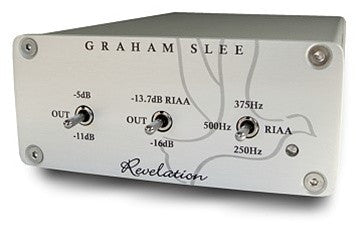
The new Graham Slee Revelation phono preamp delivers pinnacle performance for playing modern LPs, older recordings and 78s. It has 15 equalization settings to let you hear the original material exactly as it was recorded and equalized in the grooves.
Paralleled Op-amps
This is a very old technique in which two (or more) op-amps are connected in parallel, either to reduce circuit noise by 3dB, or to increase the output current by a factor of 2. In this case, it also increases the quiescent or no-signal standing current in the output stage to 2 op-amps worth (obviously). This means that for more of the signal, the output is operating within a "class A" envelope - especially the subtle signal information that is responsible for the "live" feel and the accuracy of the stereo image - which means it is not affected by output stage cross-over distortion.
Frequency Tracking Matched Time-Constant By-pass Capacitors
The trouble with so many audio designs is that:
1] although great attention is paid to high frequency stability (with some exceptions...), there is little or no understanding about low frequency stability. Looking back at some early (pre-renaissance) valve circuits, it can be seen that the time constants between local power supply decoupling and the pass frequencies of the stage, are matched. If they were not, the power supply for that section will gyrate in sympathy with the signal up to the point the decoupling becomes effective. Therefore that gyration feeds back into the signal and distorts it, and in the worst case will lead to self-oscillation. These frequencies are in the sub-bass, and if not Time-Constant matched, exhibit themselves as a "muddy" sound. (all our products have matched time-constant de-coupling)
2] It has become common practice to by-pass large capacitors with smaller ones because, very often, large capacitors have poor performance characteristics at mid to high frequencies. However, it would seem a mystery as to how the by-pass capacitor value is chosen? Many articles on the subject simply use a rule of thumb like "all electrolytics are bypassed with 100n polyester capacitors" (or similar). However, it is so easy to see using conventional engineering math, that the bypass capacitor can be chosen to start at a particular frequency from the impedance of that part of the circuit! Now, by using the argument in 1] above, the decoupling capacitor can also be bypassed such that it shares the same time-constant. Without this, the circuit is "reinforced" above a particular frequency, but the power supply to that section is not, so that the power supply becomes "loose" enabling it to again feed back (at the "rule of thumb"??? frequency). The result without is the listener is aware of "seams" between particular frequency ranges. The result with Frequency Tracking Matched Time-Constant By-pass Capacitors is a totally seamless performance from both subjective and objective observations.
Accuracy in Grounding
It will be hard for some subscribers to the hi-fi press to conceive that in many design offices circuit grounding is not fully understood. If one poses the question "why is it done in that way" the answer never seems very tangible. One manufacturer will ground a circuit at one point, whereas another manufacturer will be adamant that another point is the correct place. Looking back again to pre-renaissance valve designs you will see some disagreement, but not as "worlds-apart" as it seems to be today.
Pseudo-Differential Ground Sensing Inputs
When is a ground not a ground? Answer: When it has impedance!
If you take a journey from your (MM or MI) cartridge to the phono stage input by the earthy (ground) conductor, you will see on your travels: 1] the coil wire is attached by solder to the inside of the cartridge pin. 2] On the outside the cartridge pin has a rolled spring contact gripping onto it. 3] this contact is soldered to the thin arm wire which travels along the arm tube, loops out to pass the arm bearing, and then down the middle of the arm mount where it is attached by 4] solder to the arm plug pin. 5] The arm plug pin is in contact with the arm socket and 6] to the arm socket is soldered the screen of the arm cable. 7] at the phono stage end the screen is soldered to the body of the phono plug and 8] the phono plug body grips the phono socket.
There are 8 contact points. 3 are pressure contacts and 5 are soldered joints. All 8 exhibit some impedance, and also the metal of the wire/cable exhibits a very tiny impedance. You may think otherwise about a soldered joint but it is a joint of dissimilar metals, and so is a thermocouple. A thermocouple develops a voltage and for a potential difference to exist there must be resistance, and the AC form of resistance is impedance. Therefore there IS a voltage drop between cartridge and phono stage input which allows the voltage at the lower end of the cartridge to float above ground - there is ground current.
Those who don't understand these finer points favor balanced wiring, but unless that is done to an exacting standard, it simply won't work. It is also very inconvenient and obviously expensive in having this work done with only a suggestion of a promise that you just maybe get an increase in performance - if you're lucky. And you will be stuck with a balanced input phono stage unless you revert back to conventional turntable wiring.
The Revelation features Pseudo-Differential Ground Sensing Inputs which require no modifications to conventional turntable wiring whatsoever.
What a Pseudo-Differential input does is to float the "ground" input above ground by just more than the lumped impedance described above. A conventional grounded input does not have much of a common mode noise rejection ratio (CMRR). A balanced input has infinite CMRR, but only provided that the wiring balance is perfect. A Pseudo-Differential input has CMRR = Gain, which at hum frequencies is 58.5dB (due to equalization), or nearly 1,000:1.
It does not mean that you can get away with bad or corroded contacts along the ground path as that could exceed the expected lumped impedance, and hence hum would result as always. Also, the arm "earth" is still required as that is the only form of screening for the cartridge, and arm wires contained within.
However, it does mean that the smaller artifacts of induced mains frequency in a properly conventional-wired turntable is ignored by the phono stage, meaning that the signal is no longer modulated by it and the resultant cleaned-up signal reveals far more musical information heard in the form of greatly improved timbre. Also, as one channel could exhibit a greater ground impedance to the other, that is now ignored and therefore the stereo image is much improved.
At high frequencies there is less gain (due to equalization), but CMRR is still assisted by approximately 22dB. Therefore, although it will not cancel large radio signals which a badly screened input could pick up, any tiny radio frequencies present in a well screened input will be ignored.
High Quality Audio Electrolytes
Electrolytic capacitors are two layers of aluminum foil rolled-up with an oil-soaked paper between them as dielectric, with an oxide film anodized onto the foil as polarized insulator. You may have observed the behavior of the acid electrolyte in a car battery. The behavior inside an electrolytic capacitor is similar but on a vastly smaller scale. There is movement inside the dielectric due to the flow of AC current (the signal). The paper/oil composition within an audio electrolytic is formulated so that these movements do not introduce distortions of their own - whereas with a general purpose electrolytic the behavior is not predictable. Generally bass frequencies are more prone to distortion because of the greater energy mass contained in them. As a phono stage has 10 times more gain (due to equalization) at bass frequencies it is particularly important to place the emphasis on accuracy here.
Fast Pulse Polypropylene Capacitors
Polypropylene is a very inert plastic. It prevents almost anything sticking to it. Hence the dielectric film cannot make intimate contact with the foil and therefore there is less dielectric absorption to slow the propagation of an AC signal through them. The latest generation of Polypropylene film capacitors are made to be very fast indeed - the equivalent in amplifier terms of 1,000 volts per microsecond! However, they are not available in the values to suit the impedance of most modern phono stage equalization networks. The Revelation uses our high impedance EQ network (featured in all our phono stages) which we specially developed to exploit this property.
LP's and Singles
- Switch positions: Equalise
- 250/13.7: Early FFRR (pre '53)
- 500/11: FFRR (Decca/London). MGM, EMI, HMV, RCA, Victor, English Columbia
- 500/13.7: 240mV - 1.08V
- 500/16: 26dB ref 2mV input
78's
- Switch positions: Equalise
- 250/0: Columbia (English), EMI, HMV
- 250/5: Columbia (American 1925>), FFRR, Victor (1925> - some)
- 250/16: Columbia (American 1938>)
- 375/5: Victor (1925> - some)
- 375/11: Capitol, Early Decca, Mercury
- 500/0: Brunswick, Parlophone
- 500/S: Victor (1925> - some, and 1938-47)
- 500/11: MGM, Victor (1947>)
Graham Slee Revelation M Phono Preamp Specifications
- Input sensitivity: 2mV - 9mV (4 nominal)
- Maximum input: 45mV rms
- Nominal output: 472mV rms
- Maximum output: 5.3 V rms
- Gain: 41.5dB (118)
- Input resistance: 47k ohms
- Input capacitance: 100pf
- Noise: -68dB CCIR q pk 20Hz - 20kHz
- Distortion: 0.02%
- RIAA accuracy: 0.5dB
- Frequency response: 5Hz - 150kHz
- Channel balance: 0.2dB
- Channel separation: 64dB
- Dimensions (mm): 117w x 50h x 170d
Warranty
Should this product fail while being used for its intended purpose, within one year of purchase, we will repair or replace it at our discretion. Please contact LP Tunes for details. No other liability will be accepted. Your statutory rights are not affected.
Manufacturer
Graham Slee Projects Limited
1 Monks Way, Monk Bretton, Barnsley, S71 2JD, United Kingdom
+44(0)1226 244908 Tel/Fax
gsp.ltd@gspaudio.co.uk email
http://www.gspaudio.co.uk website
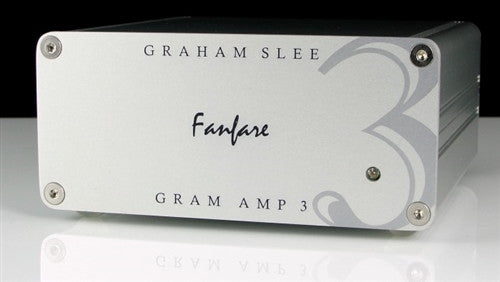
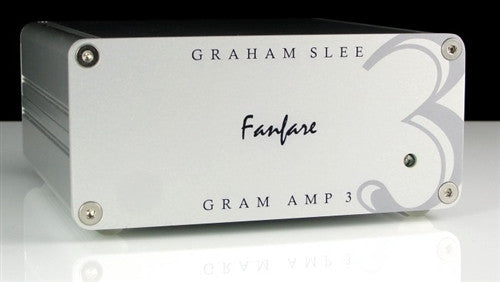
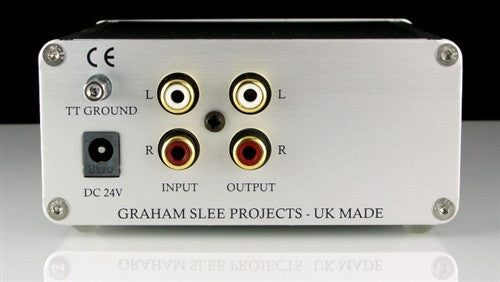
Graham Slee Gram Amp 3 Fanfare phono preamp for MC phono cartridge
The Gram Amp 3 Fanfare is a complete phono preamp for low-output MC cartridges with 0.2 - 1.0mV output.
It's always been Graham Slee's preferred method to pre-pre-amplify the tiny output of a low output moving coil cartridge and then apply it to the input of a moving magnet RIAA phono preamp. This makes perfect sense because there are precious few ways of providing the 60dB plus of gain required, with low noise, low distortion and the level of performance to capture recorded fidelity in the grooves.
The Gram Amp 3 Fanfare uses studio tape head preamp technology to bring you extreme fidelity captured in the groove. Because of Graham Slee's wide-band design capabilities they are able to utilize op-amp characteristics that are beyond current hi-fi understanding, so, at last, your moving coil cartridge can deliver its full glory. The Fanfare is not limited by the slow low noise techniques that bedevil competing moving coil amplification, and as such it will deliver real musicality while at the same time having a perceived noise floor lower than many moving magnet designs.
Single-minded optimization leads to superior results
Unfortunately the industry has been pushing the concept that one circuit can be optimized to do the two jobs of moving magnet and moving coil pre-amplification at the flick of a switch. If science were that easy then Michael Shumaker could win - at the flick of a switch - Formula 1 in the car he drives to the track in!
At the same time you are told that hi-fi separates are the only way to go for the performance you're after. Isn't it time for the hi-fi salesman to make his mind up?
The truth is that one amplifier stage can only be optimized for one narrow range of gains hence the negative feedback argument used to explain why one amplifier sounds better than another. With 20dB difference between low output moving coil and high output moving magnet, it is immediately apparent that the universal phono stage is going to let you down on one of its settings. That's usually the moving magnet one, so why bother spending over the odds for something that's going to end in disappointment?
That is why the Gram Amp 3 Fanfare is dedicated to low output moving coil and our similar looking Gram Amp 2 Special Edition is dedicated to the higher output moving magnets and high output moving coils. When you look at the prices of these two units, it is obviously cost effective to opt for one or the other, or even to buy both if you're going to be using both high and low output cartridges. You will end up paying a tiny bit more for a great deal more in musical performance.
Technology
The input impedance of the Gram Amp 3 Fanfare is fixed at 470 ohms which was found to present the optimum load for the vast majority of moving coil cartridges.
The source impedance of a low output moving coil is around 10 ohms and a load greater than 200 ohms is needed so as not to noticeably load its output. Moving coil cartridge loading is like speaker damping factor in reverse. Too much load has the effect of limiting the mechanical dynamics of the stylus. It is very much like an electricity generator. Anyone observing a fairground generator truck knows that the engine note goes low as the load of the ride is applied. By the same virtue, the stylus is stiffened against the groove with too much load (too low a resistance) which will not only compress the dynamics but also introduce distortion to the peaks. Therefore a slightly higher than recommended 470 ohms brings a beneficial effect to dynamism.
Graham Slee Gram Amp 3 Fanfare MC Phono Preamp Specifications
- Input sensitivity range: 0.2 - 1.0mV
- Maximum input: 4.4mV
- Output from above inputs: 238 - 1190mV rms
- Maximum output: 5.3 V rms
- Gain: 61.5dB (1190mV)
- Input resistance: 470 ohms
- Input capacitance: 100pf
- Noise: -63dB CCIR q pk 20Hz - 20kHz
- Distortion: 0.03%
- RIAA accuracy: 0.5dB
- Frequency response: 19Hz -150kHz
- Channel balance: 0.2dB
- Channel separation: 64dB
- Dimensions (mm): 71"w x 72"h x 118"d
Warranty
Should this product fail while being used for its intended purpose, within one year of purchase, we will repair or replace it at our discretion. Please contact LP Tunes for details. No other liability will be accepted. Your statutory rights are not affected.
Manufacturer
Graham Slee Projects Limited
1 Monks Way, Monk Bretton, Barnsley, S71 2JD, United Kingdom
+44(0)1226 244908 Tel/Fax
gsp.ltd@gspaudio.co.uk email
http://www.gspaudio.co.uk website